Are air fryers healthy?
60% of British kitchens now have one on the worktop, but are air fryers actually making us eat better, or have we just found a different way to eat chips? The mechanics genuinely do something different to food, but the appliance itself can’t make a decision for you about what goes in the basket.
How healthy are air fryers? quick answer
While they can cook with less fat than traditional frying, air fryers tend to go hand-in-hand with processed convenience foods
How an air fryer actually cooks food
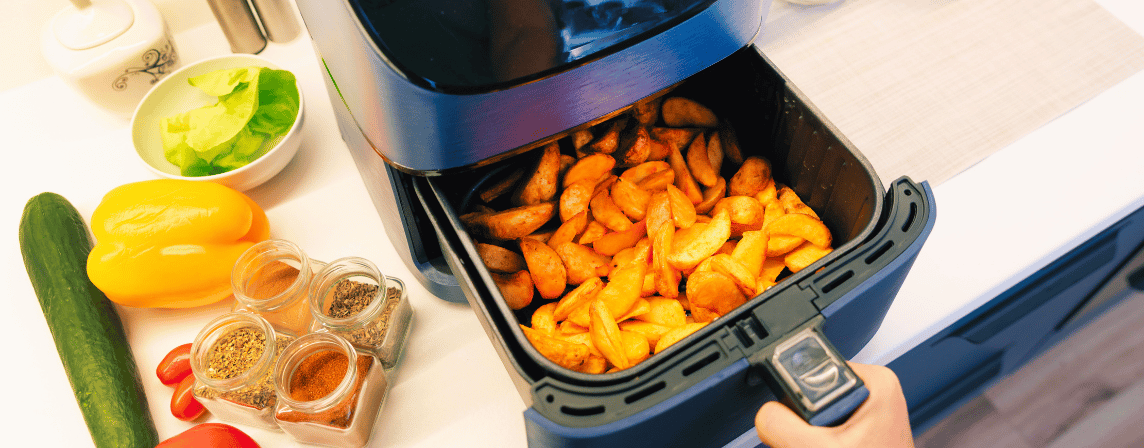
An air fryer is basically just a compact convection oven with a marketing budget. A fan circulates air heated to somewhere between 180°C and 230°C rapidly around the food, so the heat reaches nearly every surface at once. That fast-moving hot air strips moisture from the food’s exterior quickly, triggering the same browning, flavour-building chemistry responsible for a good sear on a steak or a crust on bread; without drenching the food in oil.
An air fryer can crisp food with as little as a tablespoon of oil, although many of us never use any oil at all. The crispy exterior of air-fried food forms from rapid dehydration and hot air contact rather than oil penetration.
Does air-frying preserve more nutrients?
This is where the marketing starts to shine. There’s reasonable evidence that air frying can preserve heat-sensitive antioxidants such as vitamin C and vitamin E better than deep frying, largely because of shorter cooking times. Some research also points to improved digestibility for air-fried potatoes and meat compared with their deep-fried equivalents.
The other side of the picture is acrylamide, the compound that forms in starchy foods such as chips at high heat. This has been cited as a possible carcinogen at high exposure levels but some sources report acrylamide levels 78–90% lower in air-fried potatoes than deep-fried ones.
The safest general conclusion: air frying doesn’t destroy nutrients any more than other dry-heat cooking, and it can preserve some heat-sensitive vitamins better than boiling or deep frying. But any claims that it’s dramatically better nutrient-for-nutrient than a fan oven don’t hold up. Recent tests by Which? found air fryers roughly equivalent to a conventional oven for fat content, since neither method causes food to absorb oil the way submersion frying does.
Featured Fact
Most air fryers will need a lower temperature and/or less cooking time than a fan oven, so check the food at the halfway point to avoid overcooking.
Source: https://www.bbc.co.uk/food/articles/c78j558n8n1o
Air frying vs deep fat frying
This is the clearest win for the air fryer as submerging food in oil means real oil absorption. Chips cooked in a traditional deep-fat fryer take on noticeably more fat and calories than the same chips air-fried with a tablespoon of oil. If you’re replacing a chip pan or deep-fat fryer with an air fryer for the same foods, you will generally cut fat and calorie content meaningfully, though this can vary a lot by recipe and how much oil you were using before.
Air frying vs pan frying
Shallow frying in a pan uses less oil than deep frying but still relies on direct contact with a hot, oiled surface, which means uneven heat distribution and food that needs turning to crisp evenly. Air frying’s circulating hot air reaches the food from different sides at once, which is why it can replicate a fried texture on foods like chicken thighs or halloumi without the oil residue shallow frying leaves in the pan and on the food.
Air frying vs microwaving
Microwaves cook by agitating water molecules directly inside the food, which is fast and requires no added fat. This method can actually retain more vitamin C than boiling because there’s minimal water for water-soluble vitamins to leach into. What microwaving can’t do is brown or crisp, but this is what an air fryer is built to deliver. In practice the two are complementary rather than competing: a microwave suits vegetables and reheating, an air fryer suits any foods you would want to be crispy or crusty.
How air fryers influence eating habits
Food manufacturers have moved fast to capture the air fryer boom, and what they’ve mostly launched is ultra-processed convenience food. Major manufacturers have reworked frozen pizzas, pocket sandwiches and “fakeaway” ready meals specifically for air fryer cooking, and new air-fryer-branded snack lines have launched at pace. These products are, by their nature, usually made with industrial oils, flash-frozen after pre-frying, and carry the sodium, preservatives and additive loads typical of ultra-processed food, whatever the appliance they’re designed for. An air fryer doesn’t un-process a product that arrived at your door highly processed; it just cooks it conveniently.
Convenience has a role to play in poor diet. One of the quieter mechanisms behind overeating is simply friction, ie how much effort, time and mess stand between wanting a food and having it. Throw frozen nuggets or chips into the air fryer, wait ten minutes and you have your meal ready with minimal prep or washing up. Reducing that friction is exactly why people report cooking convenience food more often and more spontaneously once they own an air fryer. The concern, reasonably raised by nutrition commentators, is that removing the effort barrier from fried, salty, moreish food makes it easier to eat that way as a matter of habit rather than as an occasional treat, particularly when snacking or eating in front of a screen rather than at a considered mealtime.
An air fryer is a genuinely useful piece of kitchen kit. It cooks with far less oil than deep or shallow frying, can preserve heat-sensitive nutrients at least as well as an oven, and for many households has reduced takeaways. What it hasn’t done is turn ultra-processed food into health food, or remove the basic nutritional logic that what you cook matters more than how you cook it. Use it for vegetables, fish, chicken and homemade chips with a light coating of oil, and it’s one of the better appliances in the kitchen. Use it exclusively for reheating breaded, pre-fried convenience food because it’s the path of least resistance, and you’ve mostly just found a quicker way to do what you were doing before.