How healthy is your bread?
Healthiest bread: quick answer
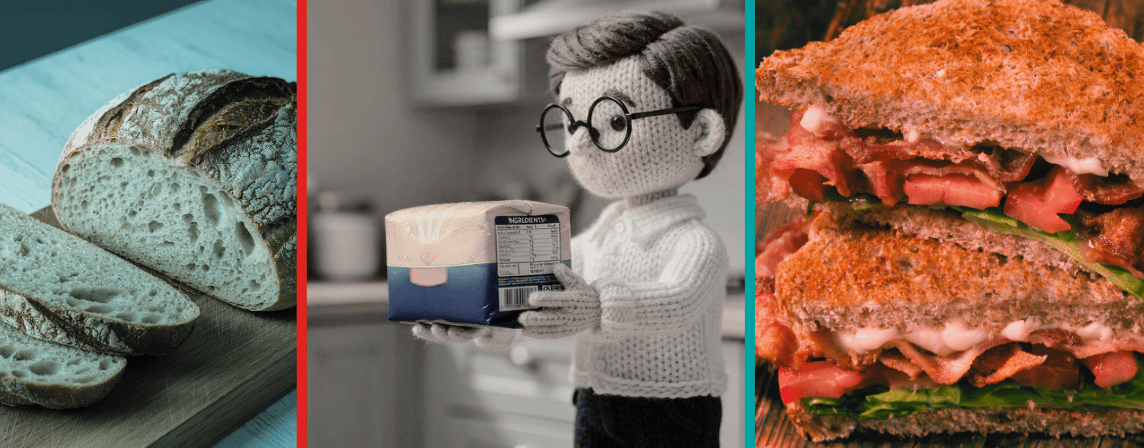
Mass-produced bread contains added preservatives and emulsifiers for stability and shelf life, whereas traditionally baked bread has just four ingredients and is eaten fresh
Bread is one of the most popular food items to buy. Every supermarket has several different brands, styles and slice options to suit any sandwich, or you can buy ready-made sandwiches from the chiller cabinet. Even your local corner shop will have some on the shelf.
However, the modern, popular loaf is quite different from the product traditionally made of just four ingredients; flour, water, yeast and salt. The same fundamental recipe and baking method has sustained civilisations for thousands of years, so why do most of us buy from a supermarket?
How commercial bread is made
The ingredients of the UK’s most popular bread are:
- Wheat Flour (with added Calcium, Iron, Niacin, and Thiamin)
- Water
- Yeast
- Salt
- Vegetable Oils (Rapeseed and Sustainable Palm)
- Soya Flour
- Preservative: Calcium Propionate (E282)
- Emulsifiers: E472e, E481;
- Flour Treatment Agent: Ascorbic Acid (Vitamin C)
The first four are the basics, but the additional ingredients each serve an industrial purpose. Soya flour adds protein and helps with binding. The vegetable oils, rapeseed and palm, soften the loaf and extend freshness. Calcium Propionate is an antifungal preservative that inhibits mould growth. The emulsifiers, E472e (diacetyl tartaric acid esters of mono- and diglycerides of fatty acids) and E481 (sodium stearoyl-2-lactylate), help the bread maintain its soft, pillowy texture long after baking. The ascorbic acid acts as a dough conditioner, strengthening the gluten network to cope with fast mechanical processing.
Out of necessity, commercial bread is formulated not primarily for flavour or nutrition, but for consistency, yield and shelf life.
The Chorleywood Bread Process, developed in the 1960s, replaced the traditional hours-long baking routine with a shorter, intense process with added ingredients. This made bread cheaper and quicker to produce and vastly extended its shelf life.
To compensate for the reduced fermentation stage, manufacturers turned to additives. These emulsifiers, enzymes and chemical dough conditioners are now a regular occurrence on bread labels. Calcium propionate, used widely as a mould inhibitor, has in some animal studies been shown to interfere with insulin production, though research in humans is ongoing.
The local village bakery
Before supermarkets, before Chorleywood, before plastic-wrapped sliced loaves, bread was made and bought locally. For centuries, the village baker was one of the most important figures in English rural life; as essential to the community as the church or the pub.
Bakers operated under strict guild regulations as far back as the 12th century, with subsequent royal charters regulating the price and weight of a loaf. Different varieties of bread emerged according to regional tastes and innovations. Then in the 20th century the arrival of plant bakeries, motorised distribution networks, and eventually supermarkets made it possible to supply an entire region from a single factory. Village bakeries closed, one by one.
French bred fresh bread
The daily ritual of fresh bread is still alive in the boulangeries and artisan shops of modern France. Baguettes and boule loaves are bought to be eaten the same day, with yesterday’s baguette assigned only for soup or toast.
The Décret Pain of 1993 defines by law what constitutes a traditional French baguette: it must be made with only flour, water, yeast, and salt. No additives nor preservatives. A boulangerie that calls itself artisan cannot use frozen dough or premixes.
As a result, over 30,000 independent boulangeries still operate across France, many of them baking through the night. Their loaves last 24 hours, perhaps 36. But nobody expects them to last a week, because nobody buys in bulk from a boulangerie.
Italy, Germany, and Spain maintain similarly strong traditions of local, fresh bread: dark rye loaves in Bavaria, sourdough ciabatta in Lombardy, pan de cristal in Catalonia. These are countries where industrialised bread exists but has not yet entirely replaced the local baker.
British vs American bread
The ingredients list above is for Warburtons Toastie White, the best-selling sliced bread in the United Kingdom. Wonder Bread, the iconic American white loaf, is a different story.
Where the Warburtons example lists two emulsifiers, Wonder Bread lists five or six, depending on the variant. While a British loaf uses a small amount of vegetable oil, the American equivalent includes multiple conditioning agents designed to stabilise the product across weeks of shelf life. Sugar, one of the first listed ingredients, adds sweetness that British palates would find unusual in a savoury bread.
Wonder Bread typical ingredients:
- Enriched flour (with niacin, reduced iron, thiamin mononitrate, riboflavin, and folic acid)
- Water
- Sugar
- Yeast
- Soybean and/or canola oil
- Sodium stearoyl lactylate
- Calcium stearoyl lactylate
- Monoglycerides and diglycerides
- Distilled monoglycerides
- DATEM (diacetyl tartaric acid esters of mono- and diglycerides)
- Ethoxylated mono- and diglycerides
- Calcium peroxide
- Calcium iodate
- Soy lecithin
- Calcium propionate
- Citric acid
- Monocalcium phosphate
Some versions also contain high-fructose corn syrup. To put this into context, North America has one of the highest rates of ultra-processed food consumption in the developed world, and industrialised bread is a significant contributor.

How to bake healthy bread without a bread maker
Ingredients
- 7g fast action yeast
- 300ml warm water
- 1.5 tsp salt
- 500g Strong white bread flour
Optional:
- 2-3 tablespoons of extra virgin olive oil (or butter)
- Small blob of golden syrup
Before you start, give your worktop a good clean and make sure it’s dry before you put the dough on there.
You’ll need 300ml of warm water, then put your fast action yeast into a container with a little bit of golden syrup. Add some of this warm water, give it a stir and leave it for about 10 minutes.
While you wait you can start mixing the other ingredients. Get some very strong white bread flour with at least 13g of protein per 100g. The one I use is a bit stronger and helps get a really good result. Measure out 500 grams into your mixing bowl and add three tablespoons of extra virgin olive oil and just over a teaspoon of salt. I do 8-10 seconds on the electric grinder.
After 5-10 minutes your yeast mixture should be nice and foamy and thick, so you can add this into your main mix.
Give it a good mix, I use a hand mixer with dough hooks so you’re mixing and kneading with the same kit. Add in the rest of the warm water and continue to mix, then you can use your hands to mop up the loose dry bits.
Sprinkle a bit of flour onto your work surface, I usually use a separate bag of flour so that I get three loaves from a kilo and a half bag of the decent flour.
Finish your kneading by hand and make sure it’s smooth and stretchy. To prove the dough I use a special setting on my oven or in the winter I leave it by a radiator.
Oil the bowl and put the kneaded dough back in to rise to about twice the size. Put in the warm place for about an hour, and then punch the air out of it, work it around again with some flour and put it into a floured baking tin. I like to add seasoning to the top at this stage to add some flavour to the crust.
Pop it back to your warm place for another 30-45 minutes until it’s nicely bulging over the top. Then preheat your oven to 200 degrees, and bake for 30 minutes. I like to take it out of the pan about 5 minutes early and turn upside down so it properly bakes the bottom.
Let it cool on a rack for about half an hour and you have a nice healthy loaf with a crunchy crust that tastes delicious.