
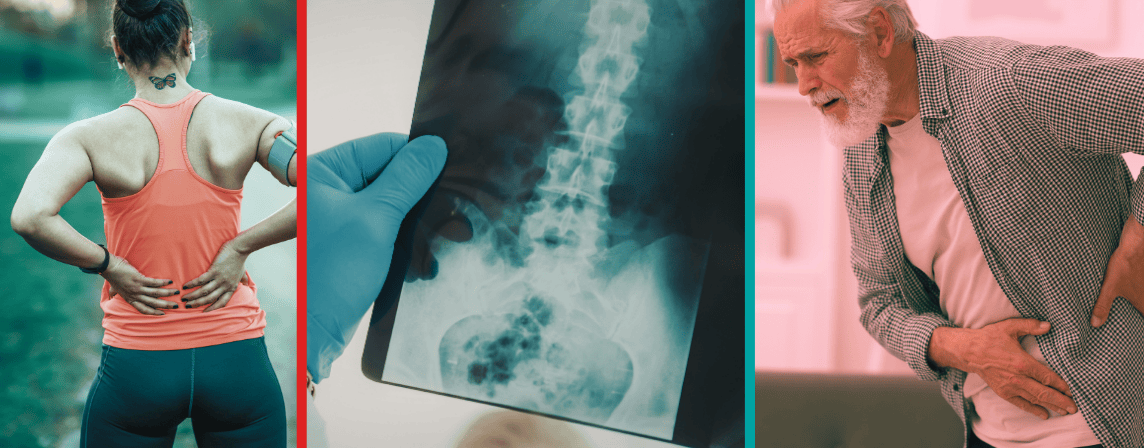
Understanding back injuries
Spine injury: 10-second summary
- Slipped disc: A broad term for bulging or prolapsed disc.
- Common causes: Poor posture and prolonged sitting.
- Typical solution: Pain relief to facilitate movement.
Back pain is a common health complaint in the United Kingdom, affecting approximately 80% of people at some point during their lives. Causes can include poor posture and muscle strain as well as degenerative conditions, but injuries to the intervertebral discs are among the most common.
Between each of the 33 vertebrae are the discs, which are squishy pads that act as shock absorbers. These discs consist of a tough outer ring and a gel-like core that provides the cushioning.
What is a slipped disc?
A common term for a spinal disc injury is a ‘slipped disc‘, which implies that a disc literally slips out of place. However, what usually occurs is a bulging of the disc and/or a tear in its outer layer. More accurate terms include herniated disc, ruptured disc and prolapsed disc.
Herniated disc
Disc herniation occurs when the soft inner part of a disc pushes through a weakness in the surface, while remaining contained within the outer layer. The condition can resolve itself over time without surgery.
Prolapsed disc
Disc prolapse describes a more advanced condition where the nucleus pulposus (inner part) has bulged beyond the annulus fibrosus and towards the spinal nerve.
Symptoms of spinal disc injury
- Localised burning pain in the back or neck
- Radiating pain down the sciatic nerve towards the leg
- Loss or change in sensation in the limbs
- Muscle weakness in limbs
If you experience loss of bladder or bowel control this is a medical emergency as it may be Cauda equina syndrome.
Causes and risk factors of disc injury
As opposed to an isolated incident when someone moves awkwardly and suddenly their back ‘goes’, disc injury is often caused by a combination of sustained mechanical strain.
| Lifestyle Factor | How It Causes Disc Injury | How to Prevent It |
|---|---|---|
| Heavy or Repetitive Lifting | Bending from the waist rather than the knees places enormous compressive and shear forces on the lumbar discs. Repetitive lifting in occupational settings significantly elevates the risk of herniation. | Always bend at the knees, keep the load close to the body, and avoid twisting whilst bearing weight. Seek assistance for objects too heavy to lift safely alone. |
| Prolonged Sitting & Sedentary Lifestyle | Sustained sitting — especially with poor posture — places continuous pressure on lumbar discs. Research has shown disc pressure is actually higher when seated than when standing. | Take regular breaks to stand and move every 30–60 minutes. Engage in regular low-impact exercise such as swimming, walking, or cycling to promote nutrient diffusion into disc tissue. |
| Weak Core Muscles | Without adequate muscular support from the abdomen, lower back, pelvis, and hips, a greater share of spinal load is transferred directly onto the intervertebral discs, increasing injury risk. | Incorporate targeted core exercises into your routine. The plank, dead bug, and bird-dog are particularly effective for building spinal support. |
| Obesity & Excess Body Weight | Excess weight increases compressive load on the spinal column, accelerating degenerative changes and raising the likelihood of disc herniation, particularly in the lumbar spine. | Maintain a healthy weight through a balanced diet and regular activity. Even modest weight loss has been shown to meaningfully reduce back pain symptoms. |
| Smoking | Smoking impairs blood supply to the intervertebral discs, which rely on diffusion for nutrition. Research has consistently linked smoking to accelerated disc degeneration. | Stop smoking. The NHS offers free stop-smoking services with evidence-based support to help you quit. |
| Occupation & Physical Demands | Roles involving repetitive bending, twisting, vibration, or sustained awkward postures carry high risk. Paradoxically, both highly sedentary and highly physical occupations are associated with elevated rates of disc injury. | Invest in a properly adjusted ergonomic workstation. Alternate between sitting and standing where possible, and follow correct manual handling techniques. |
| Poor Posture | Poor posture — whether sitting, standing, or sleeping — creates uneven mechanical loads across the spinal discs, causing localised stress concentrations that accelerate wear and raise injury risk. | Practise spinal-neutral positions throughout daily activity. Ensure your chair, mattress, and workstation support correct alignment when sitting, sleeping, and working. |
| Genetic Predisposition | Evidence from twin studies suggests a substantial hereditary component to disc degeneration. Structural vulnerabilities in disc tissue can be inherited, making some individuals more susceptible regardless of lifestyle. | Cannot be prevented directly, but risk can be mitigated by maintaining a healthy weight, staying active, and avoiding all other modifiable risk factors. |
Treatments for disc injury
The approach in the UK to address spinal disc issues typically begins with non-invasive intervention, but the course of treatment can vary according to severity and response to rest and exercise.
Non-surgical treatments
A short period of rest can be suitable, although prolonged bed rest is not recommended. A gradual return to normal activity is encouraged whenever pain permits, as this accelerates healing.
Over-the-counter painkillers such as paracetamol and codeine are the common first option for acute back pain. Prescription painkillers can include stronger doses of codeine or dihydrocodeine with paracetamol, but also muscle relaxants and anti-depressants, which can be effective for nerve pain.
The cornerstone of disc injury rehabilitation is physiotherapy. A physiotherapist would look at reducing pain, increasing movement and building strength; so the injured area can heal.
Patients often use hot and cold therapy alongside one of the other treatments above. Topical heat can help relax the area and improve blood flow, while ice packs ca help reduce inflammation and numb pain.
Painkilling injections
Epidural steroid injections can be administered in cases where nerve root compression causes severe or persistent sciatic pain. A steroid is injected into the space around the affected nerve root to reduce inflammation and provide temporary pain relief and aid rehabilitation.
Nerve root blocks work in a similar way to epidural injections, with the painkilling injection targeting the nerve root to facilitate physical recovery.
Surgery for disc injury
Surgery is generally only considered once rehabilitation has been encouraged through pain relief and physiotherapy. The most effective treatments for back injury tend to be managed exercise, however there are surgical options further down the line.
The most common surgery option is discectomy, which is the removal of the disc material that is pressing on the nerve. This is very effective at relieving sciatic pain, but does not fix the underlying degeneration of the disc.
Spinal fusion is a rather more extreme procedure whereby two vertebrae are fused together where the disc would have been. This eradicates disc bulge in that particular area, but reduces flexibility and can increase the risk of adjacent degeneration.
Disc replacement involves replacing the damaged disc with a prosthetic one. This is more commonly applied to the cervical (neck) area than lumbar.